


GPQA: A Graduate-Level Google-Proof Q&A Benchmark
Paper • 2311.12022 • Published • 36
Using non-standard (forked) LLaMA C++ release b8990 for quantization.
Original model: Qwen/Qwen3.6-35B-A3B
From the original model creators:
Qwen3.6-35B-A3B

This repository contains model weights and configuration files for the post-trained model in the Hugging Face Transformers format.
These artifacts are compatible with Hugging Face Transformers, vLLM, SGLang, KTransformers, etc.
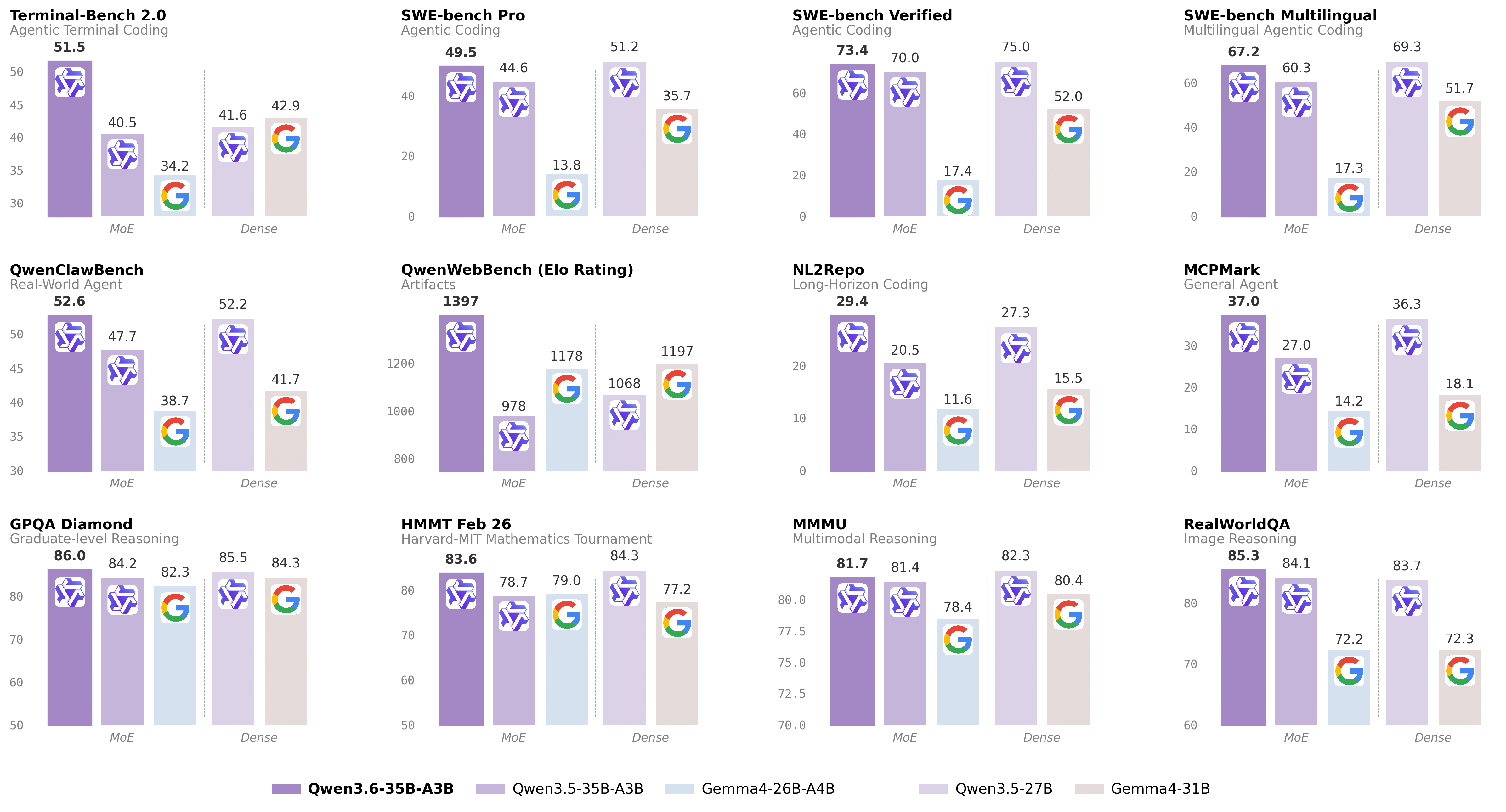
Following the February release of the Qwen3.5 series, we're pleased to share the first open-weight variant of Qwen3.6. Built on direct feedback from the community, Qwen3.6 prioritizes stability and real-world utility, offering developers a more intuitive, responsive, and genuinely productive coding experience.
Qwen3.6 Highlights
This release delivers substantial upgrades, particularly in
- Agentic Coding: the model now handles frontend workflows and repository-level reasoning with greater fluency and precision.
- Thinking Preservation: we've introduced a new option to retain reasoning context from historical messages, streamlining iterative development and reducing overhead.
For more details, please refer to our blog post Qwen3.6-35B-A3B.
An area of personal interest is finding ways to optimize the inference performance of LLMs when deployed in resource-constrained environments like commodity hardware, desktops, laptops, mobiles, edge devices, etc. There are many approaches to accomplish this, including architecture simplification and knowledge distillation, but my focus has been primarily on quantization and pruning.
The method to produce these experimental versions involves using a custom version of llama-imatrix to generate an imatrix that includes tensor statistics, and a custom version of llama-quantize, which computes a per-tensor quantization error, to automatically select the lowest error quantization recipe that achieves a global target bits‑per‑weight (bpw). More details on the implementation and test results here
There are two pull requests (#14891 & #15550) to merge these changes back into the core llama.cpp project. This may or may not ever happen so, until then, the modified versions will be available on GitHub.
For testing and comparison, I use models produced by Bartowski (see credits below) and Unsloth (Daniel and Michael Han do some really interesting stuff!) but when they don't provide versions of the required model, tests and comparisons are against standard quantization obtained by simply running llama-quantize with no further optimizations.
All experimental versions were generated using an appropriate imatrix created from datasets available at eaddario/imatrix-calibration. In llama.cpp, an imatrix is a calibration file derived from running representative text through the model and collecting activation statistics. It is used to weight quantization error so that error in more “important” directions (as estimated from activations) is penalized more heavily.
The process to generate these models is roughly as follows:
llama-quantize --target-bpw 4.5678 --state-file --imatrix imatrix.gguf baseline-model-F16.gguf 12)A common concern when converting BFloat16 (BF16) models to Float16 (F16) is the potential for accuracy loss. Specifically:
Crucially, when the F16 model is subsequently used for quantization, the resulting degradation in metrics like Perplexity (PPL) or Kullback–Leibler Divergence (KLD) is minimal. Any variations are typically restricted to the hundreds or thousandths decimal places compared to the BF16 model.
However, considering that weight clipping presents a more substantial risk to model integrity, every BF16 base model undergoes validation prior to the conversion process. Consequently, no models hosted in this repository exhibit performance degradation due to overflow clipping.
While BF16 offers precision benefits, performance remains a key factor.
convert_hf_to_gguf.py, show a notable performance difference, with conversion to BF16 being 15–30% slower than to F16.The choice to prioritize F16 over BF16 is driven by a focus on maximizing performance in specific deployment environments. My primary objective is not large-scale quantization production, a domain where others like Bartowski and Unsloth excel at, but rather optimizing inference performance for resource-constrained environments. Since BF16 support is not yet widespread in areas like mobile, edge, and embedded devices, using F16 ensures broader compatibility and easier optimization for these use cases.
Target arbitrary size models
--target-bpw 4.5678 for instance, the algorithm will produce a model (nearly) exactly of that size, which is very useful for maximizing VRAM usage. In a system with 24GB VRAM and a 70B model, standard quants might produce a 16.8GB file (too small, quality left on table) or a 24.1GB file (won't fit). This approach can generate a 23.85GB file to utilize the hardware fully.Data-driven mixed precision often can improve quality at fixed size
Instead of using hardcoded heuristics (e.g. make attn_v Q5_K for a 70B model), that may be sub‑optimal for a given architecture or size, the quantization mix is determined by the actual error sensitivity of the specific model's weights. This, in practice, often yields a better quality/size trade-off, especially in aggressive quantization scenarios (1.5 to 3.5 bpw), or for unusual architectures.
Please note: llama.cpp’s heuristics have been tuned across many models and are highly optimized; although the target bpw method produces better quality often (>75% based on tests with 130 models from 11 different families), it can also lose in surprising cases.
Allows better like-for-like comparisons between models and families
Standard llama.cpp quantization uses hardcoded rules like: "use Q4_K_M, except bump some tensors up/down, except fall back if incompatible, except keep some tensors unquantized..." and for that reason, two different models quantized with the same Q4_K_M type can end up with very different bpw (e.g. 4.75 and 4.30).
All things being equal, the performance of a model is usually proportional to its overall bpw size; models with a higher bpw tend to perform better than lower bpw models. Since model A has simply been given more bits, it will typically perform better (lower perplexity, better eval scores, etc.) even if the underlying quantization method is identical. That makes comparing the performance not a controlled experiment, because the comparison is between models with different effective compression ratios.
--target-bpw tries to address that by making the experiment more controlled: each model gets quantized to land on (approximately) the same global byte budget, so that the models' performance differences are more attributable to architecture/training differences, quantization error behaviour at the same compression ratio, optimizer’s allocation decisions, etc.
Quantization process is significantly slower than standard
This approach can take 5x-10x longer as it quantizes a sample of most tensors into 15 different formats, dequantizes them back to floats, computes error diffs, and selects the best size/error option that fits the global bpw budget.
However, the --state-file option will save/use the above-mentioned computations so that future quantizations, for the same model, can be generated at normal speed. It also allows to interrupt the computation process and resume it at a later time.
The optimization target is only a proxy for the model's performance quality
An imatrix with activations data is required for best results
--target-bpw option will refuse to run.| Model | BPW | Size (GB) | μPPL | 𝜌PPL | μKLD | Same Top-P |
|---|---|---|---|---|---|---|
| Qwen3.6-35B-A3B-F16 | 16.0103 | 65.0 | 6.270267 ±0.039764 | 100% | N/A | N/A |
| Qwen3.6-35B-A3B-Q2_K | 1.7500 | 7.1 | 19.727704 ±0.154377 | 77.72% | 1.223315 ±0.003379 | 54.832 ±0.129 |
| Qwen3.6-35B-A3B-Q2_K | 2.5000 | 10.0 | 9.699612 ±0.066197 | 89.27% | 0.514580 ±0.001852 | 69.313 ±0.120 |
| Qwen3.6-35B-A3B-Q3_K | 3.5000 | 14.0 | 7.265556 ±0.047435 | 96.15% | 0.180509 ±0.000844 | 80.474 ±0.103 |
| Qwen3.6-35B-A3B-Q4_K | 4.5000 | 18.0 | 6.517143 ±0.041405 | 98.64% | 0.061493 ±0.000473 | 89.092 ±0.081 |
| Qwen3.6-35B-A3B-Q5_K | 5.5000 | 22.0 | 6.341921 ±0.040406 | 99.38% | 0.026679 ±0.000332 | 92.981 ±0.066 |
| Qwen3.6-35B-A3B-Q6_K | 6.5000 | 26.0 | 6.297517 ±0.039973 | 99.68% | 0.013373 ±0.000264 | 95.214 ±0.055 |
| Qwen3.6-35B-A3B-Q7_K | 7.5000 | 30.0 | 6.261129 ±0.039683 | 99.82% | 0.007794 ±0.000211 | 96.421 ±0.048 |
| Qwen3.6-35B-A3B-Q8_0 | 8.5000 | 34.0 | 6.268898 ±0.039745 | 99.86% | 0.005965 ±0.000249 | 97.057 ±0.044 |
Scores generated using llama-perplexity with 750 tasks per test, and a context size of 1024 tokens.
For the test data used in the generation of these scores, follow the appropriate links: ARC Challenge, Truthful QA, GPQA-Diamond, HellaSwag, MMLU-Redux, WinoGrande
| Model | ARC Challenge | GPQA-Diamond | HellaSwag | MMLU-Redox | Truthful QA | WinoGrande | Avg Score |
|---|---|---|---|---|---|---|---|
| Qwen3.6-35B-A3B-Q1_L | 53.0667 ±1.8235 | 21.2121 ±2.9127 | 82.67 | 55.3333 ±1.8165 | 29.0667 ±1.6591 | 60.6667 ±1.7849 | 50.34 |
| Qwen3.6-35B-A3B-Q2_K | 58.6667 ±1.7993 | 25.7576 ±3.1156 | 72.40 | 70.4000 ±1.6680 | 33.6000 ±1.7259 | 67.8667 ±1.7063 | 54.78 |
| Qwen3.6-35B-A3B-Q3_K | 65.2000 ±1.7405 | 28.2828 ±3.2088 | 81.07 | 79.0667 ±1.4865 | 36.5333 ±1.7594 | 72.2667 ±1.6358 | 60.40 |
| Qwen3.6-35B-A3B-Q4_K | 67.3333 ±1.7137 | 28.7879 ±3.2259 | 82.00 | 83.6000 ±1.3530 | 38.9333 ±1.7816 | 74.0000 ±1.6027 | 62.44 |
| Qwen3.6-35B-A3B-Q5_K | 66.2667 ±1.7276 | 26.2626 ±3.1353 | 82.67 | 84.6667 ±1.3165 | 38.9333 ±1.7816 | 74.8000 ±1.5864 | 62.27 |
| Qwen3.6-35B-A3B-Q6_K | 66.1333 ±1.7292 | 29.7980 ±3.2586 | 82.53 | 84.1333 ±1.3350 | 39.0667 ±1.7827 | 74.2667 ±1.5974 | 62.65 |
| Qwen3.6-35B-A3B-Q7_K | 66.6667 ±1.7225 | 26.7677 ±3.1544 | 82.27 | 84.1333 ±1.3350 | 38.8000 ±1.7805 | 73.0667 ±1.6209 | 61.95 |
| Qwen3.6-35B-A3B-Q8_0 | 66.8000 ±1.7207 | 27.7778 ±3.1912 | 82.00 | 83.8667 ±1.3441 | 39.7333 ±1.7880 | 74.2667 ±1.5974 | 62.41 |
Scores generated using llama-bench. Standard (llama-quantize with no optimization) Q4_K_M quantization included for comparison.
| model | size | params | backend | threads | test | t/s |
|---|---|---|---|---|---|---|
| Qwen3.6-35B-A3B-Q1_L | 7.06 GiB | 34.66 B | BLAS,MTL | 12 | pp512 | 1437.34 ±10.43 |
| Qwen3.6-35B-A3B-Q1_L | 7.06 GiB | 34.66 B | BLAS,MTL | 12 | tg128 | 83.93 ±0.41 |
| Qwen3.6-35B-A3B-Q1_L | 7.06 GiB | 34.66 B | BLAS,MTL | 12 | pp1024+tg1024 | 151.24 ±1.92 |
| Qwen3.6-35B-A3B-Q2_K | 10.09 GiB | 34.66 B | BLAS,MTL | 12 | pp512 | 1407.65 ±37.52 |
| Qwen3.6-35B-A3B-Q2_K | 10.09 GiB | 34.66 B | BLAS,MTL | 12 | tg128 | 79.43 ±0.31 |
| Qwen3.6-35B-A3B-Q2_K | 10.09 GiB | 34.66 B | BLAS,MTL | 12 | pp1024+tg1024 | 146.66 ±1.65 |
| Qwen3.6-35B-A3B-Q3_K | 14.12 GiB | 34.66 B | BLAS,MTL | 12 | pp512 | 1428.03 ±8.09 |
| Qwen3.6-35B-A3B-Q3_K | 14.12 GiB | 34.66 B | BLAS,MTL | 12 | tg128 | 81.50 ±0.86 |
| Qwen3.6-35B-A3B-Q3_K | 14.12 GiB | 34.66 B | BLAS,MTL | 12 | pp1024+tg1024 | 146.92 ±0.84 |
| Qwen3.6-35B-A3B-Q4_K | 18.16 GiB | 34.66 B | BLAS,MTL | 12 | pp512 | 1414.53 ±5.33 |
| Qwen3.6-35B-A3B-Q4_K | 18.16 GiB | 34.66 B | BLAS,MTL | 12 | tg128 | 77.78 ±1.23 |
| Qwen3.6-35B-A3B-Q4_K | 18.16 GiB | 34.66 B | BLAS,MTL | 12 | pp1024+tg1024 | 141.46 ±0.39 |
| Qwen3.6-35B-A3B-Q5_K | 22.19 GiB | 34.66 B | BLAS,MTL | 12 | pp512 | 1390.54 ±12.70 |
| Qwen3.6-35B-A3B-Q5_K | 22.19 GiB | 34.66 B | BLAS,MTL | 12 | tg128 | 78.46 ±0.82 |
| Qwen3.6-35B-A3B-Q5_K | 22.19 GiB | 34.66 B | BLAS,MTL | 12 | pp1024+tg1024 | 143.86 ±0.47 |
| Qwen3.6-35B-A3B-Q6_K | 26.23 GiB | 34.66 B | BLAS,MTL | 12 | pp512 | 1352.81 ±2.20 |
| Qwen3.6-35B-A3B-Q6_K | 26.23 GiB | 34.66 B | BLAS,MTL | 12 | tg128 | 73.21 ±0.38 |
| Qwen3.6-35B-A3B-Q6_K | 26.23 GiB | 34.66 B | BLAS,MTL | 12 | pp1024+tg1024 | 137.95 ±4.46 |
| Qwen3.6-35B-A3B-Q7_K | 30.26 GiB | 34.66 B | BLAS,MTL | 12 | pp512 | 1413.76 ±3.87 |
| Qwen3.6-35B-A3B-Q7_K | 30.26 GiB | 34.66 B | BLAS,MTL | 12 | tg128 | 69.63 ±0.13 |
| Qwen3.6-35B-A3B-Q7_K | 30.26 GiB | 34.66 B | BLAS,MTL | 12 | pp1024+tg1024 | 129.21 ±0.42 |
| Qwen3.6-35B-A3B-Q8_0 | 34.30 GiB | 34.66 B | BLAS,MTL | 12 | pp512 | 1463.18 ±5.01 |
| Qwen3.6-35B-A3B-Q8_0 | 34.30 GiB | 34.66 B | BLAS,MTL | 12 | tg128 | 67.55 ±0.40 |
| Qwen3.6-35B-A3B-Q8_0 | 34.30 GiB | 34.66 B | BLAS,MTL | 12 | pp1024+tg1024 | 124.55 ±0.18 |
Perplexity: one of the key metrics used in NLP evaluation. It measures the quality of a language model by evaluating how well it predicts the next token given a particular sequence of words. A PPL of 1 indicates an exact match between predicted and actual, whereas values greater than one indicate a degree of "surprise" the generated token differs from the expected.
Kullback–Leibler (KL) Divergence: a statistical measure of how much a probability distribution differs from another. When quantizing models (or altering the original tensors in any way for that matter), the closest we can preserve the weights' probability distribution to the original model the better, thus the closest to 0 the better.
AI2 Reasoning Challenge (ARC): a benchmark to evaluate the ability of AI models to answer complex science questions that require logical reasoning beyond pattern matching.
GPQA-Diamond: a challenging dataset of 448 multiple-choice questions written by domain experts in biology, physics, and chemistry.
HellaSwag: the Harder Endings, Longer contexts, and Low-shot Activities for Situations With Adversarial Generations (bit of a mouthful!) is a benchmark designed to test commonsense natural language inference. It requires the model to predict the most likely ending of a sentence.
MMLU: the Massive Multitask Language Understanding evaluates LLMs’ general knowledge and problem-solving abilities across 57 subjects, including elementary mathematics, US history, computer science, and law.
Truthful QA: evaluates how well LLMs generate truthful responses to questions. It identifies whether AI models can avoid generating false or misleading information, particularly in areas where human knowledge is prone to misconceptions.
Winogrande: based on the Winograd Schema Challenge, is a natural language understanding task requiring models to resolve ambiguities in sentences involving pronoun references.
LLaMa C++ has a large and vibrant community of contributors (~1,600 last time I checked) that actively maintain and extend its functionality, adding new models and architectures almost as fast as they appear. Considering the breakneck speed at which the AI/ML field is advancing, this alone is a remarkable feat!
While I'm grateful to all contributors, I want to recognise three in particular:
Base model
Qwen/Qwen3.6-35B-A3B