
Jev AI Ecosystem Compared: 5 Platforms for Testing, Learning, and Building with Jev

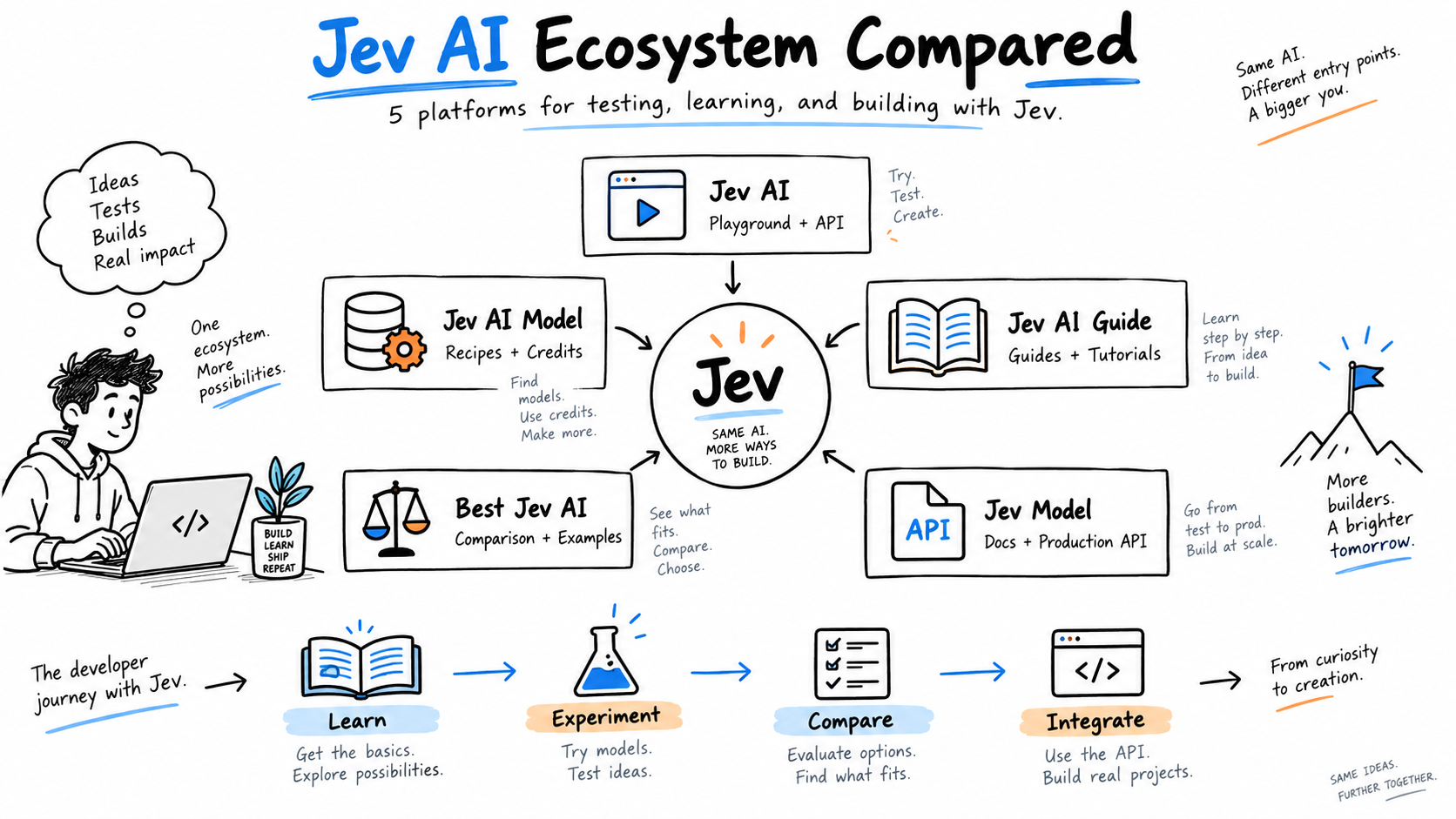 Jev is starting to attract attention among developers who need something different from a traditional generative LLM.
Instead of focusing primarily on open-ended text generation, Jev is designed around structured decisions: provide a state, define typed questions, and receive application-readable answers with probabilities or confidence information.
That makes Jev especially interesting for workflows such as classification, routing, scoring, moderation, model selection, lead qualification, and agent decision gates.
At the same time, several Jev-focused websites and developer resources have appeared, each serving a somewhat different purpose.
Some are optimized for testing Jev in a browser. Some focus on APIs. Others focus on prompts, examples, technical education, or ecosystem comparison.
This guide compares five Jev-related platforms:
The goal is not to choose a universal winner.
Instead, the useful question is:
Which Jev resource should a developer use for learning, experimentation, comparison, or production integration?
What Is Jev AI?
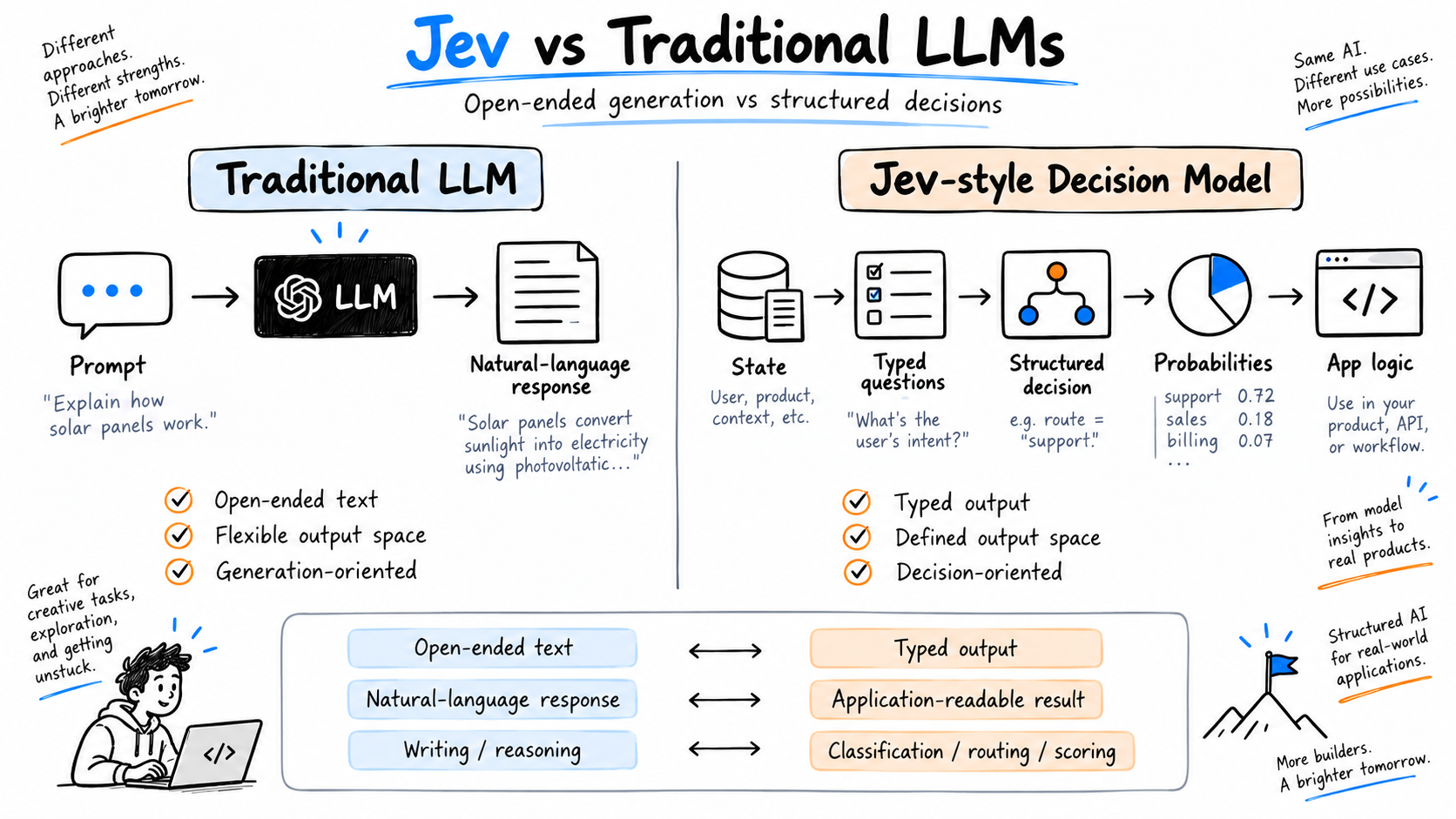 Jev can be thought of as a decision-oriented AI model rather than a general-purpose text generator.
A typical generative LLM workflow looks like this:
Prompt
  ↓
LLM
  ↓
Natural-language response
A Jev-style workflow is closer to:
State
  ↓
Typed questions
  ↓
Structured decisions
  ↓
Probabilities / confidence
  ↓
Application logic
For example, instead of asking:
Read this support message and explain what our support team should do.
you might define a more explicit contract:
{
  "state": "My payment has failed three times and I need this fixed today.",
  "questions": {
    "urgency": {
      "type": "choice",
      "options": [
        "low",
        "medium",
        "high"
      ]
    }
  }
}
The important distinction is that your application knows the possible output space before the model runs.
That makes the result easier to connect to code.
A support platform might use the result to:
- route a ticket
- prioritize a queue
- trigger manual review
- select a workflow
- choose another model
- decide whether an agent can continue
Jev-focused tools commonly expose concepts such as:
- state
- typed questions
- structured answers
- probabilities
- confidence
- parallel decisions
- application-readable outputs
This makes Jev particularly relevant when the problem is not:
"Generate something creative."
but rather:
"Choose, classify, score, or route something inside a known decision space."
Why Are There Multiple Jev AI Platforms?
A developer evaluating Jev rarely has only one question.
The actual journey often looks more like this:
What is Jev?
      ↓
How does the decision format work?
      ↓
Can I test it?
      ↓
Are there useful examples?
      ↓
How should I structure questions?
      ↓
What does the output look like?
      ↓
Can I call it through an API?
      ↓
How should I integrate it into production?
Different Jev resources focus on different parts of that journey.
That is why it is useful to look at the ecosystem in terms of developer intent instead of treating every site as an identical product.
Quick Comparison
| Platform | Primary Purpose | Playground | API | Guides / Tutorials | Prompt / Recipe Resources | Best For |
|---|---|---|---|---|---|---|
| Jev AI | Playground and developer API workflow | Yes | Yes | Yes | Examples | Developers testing structured decisions |
| Jev AI Model | Playground, reusable recipes, and credit-based API access | Yes | Yes | Some | Strong focus | Prototyping before API integration |
| Jev AI Guide | Technical learning, guides, blogs, and solutions | Not a primary focus | Not a primary focus | Strong focus | Educational | Developers learning Jev concepts |
| Best Jev AI | Independent comparison, examples, Playground, and API access | Yes | Yes | Comparison-oriented | Examples | Developers comparing Jev approaches |
| Jev Model | Playground, documentation, and production-oriented API integration | Yes | Yes | Strong focus | Examples | Developers moving from test to production |
Several of these platforms overlap.
That is expected.
The key difference is usually not whether a site has a Playground, but what kind of developer workflow it is trying to support.
1. Jev AI — thejevai.com
Jev AI provides one of the most direct ways to experiment with Jev-style structured decisions in the browser.
Its Playground centers around a simple workflow:
- provide a state
- define typed questions
- run the decision
- inspect structured outputs
- preview the corresponding API request
The Playground currently shows example workflows around tasks such as:
- viral post analysis
- SEO internal linking
- email and lead triage
- content tagging
- support routing
- content moderation
- lead scoring
- code review risk
- model routing
- tool-call risk
- résumé screening
- data extraction
The interface also exposes a request shape for a /v1/systemone endpoint, which makes the Playground more useful than a purely visual demo.
It helps developers connect what they are experimenting with in the browser to an eventual API request.
Where Jev AI Fits
Jev AI is a reasonable starting point if your main goal is:
"I want to understand what a Jev decision looks like."
It is especially useful when you want to test questions interactively before committing to an integration.
A typical workflow might be:
Business input
      ↓
Jev AI Playground
      ↓
Tune typed questions
      ↓
Inspect probabilities
      ↓
Copy API request
      ↓
Backend integration
That makes it suitable for developers who learn by experimenting rather than by reading documentation first.
2. Jev AI Model — jevaimodel.net
Jev AI Model has a somewhat different product structure.
It combines:
- a signed-in web Playground
- reusable configurations or recipes
- saved web history
- structured Jev outputs
- paid API credits
- usage visibility
Its positioning is particularly relevant for developers who want to separate experimentation from production usage.
The web Playground can be used without purchasing API credits, while API access uses a credit-based model.
The site also emphasizes reusable recipes, which can help developers start from an existing decision pattern instead of designing every question from scratch.
Why Recipes Matter
One of the biggest challenges with decision-oriented models is not API syntax.
It is question design.
For example, compare these two questions:
Is this lead good?
and:
Classify this lead as:
- low intent
- medium intent
- high intent

Use purchase urgency, company size, and explicit product interest.
The second question has a much clearer contract.
Reusable recipes can therefore be valuable because they provide examples of how other structured decision tasks can be modeled.
Possible recipe categories could include:
Lead qualification
Support ticket routing
Content moderation
SEO classification
Agent tool selection
Risk scoring
Model routing
The point is not simply to reuse prompts verbatim.
The real value is learning how to design constrained decision interfaces.
Where Jev AI Model Fits
Jev AI Model is particularly relevant for a developer workflow like:
Load example
    ↓
Modify state
    ↓
Adjust questions
    ↓
Run free web tests
    ↓
Save configuration
    ↓
Validate behavior
    ↓
Purchase API credits
    ↓
Integrate application
That makes it a useful bridge between experimentation and paid API usage.
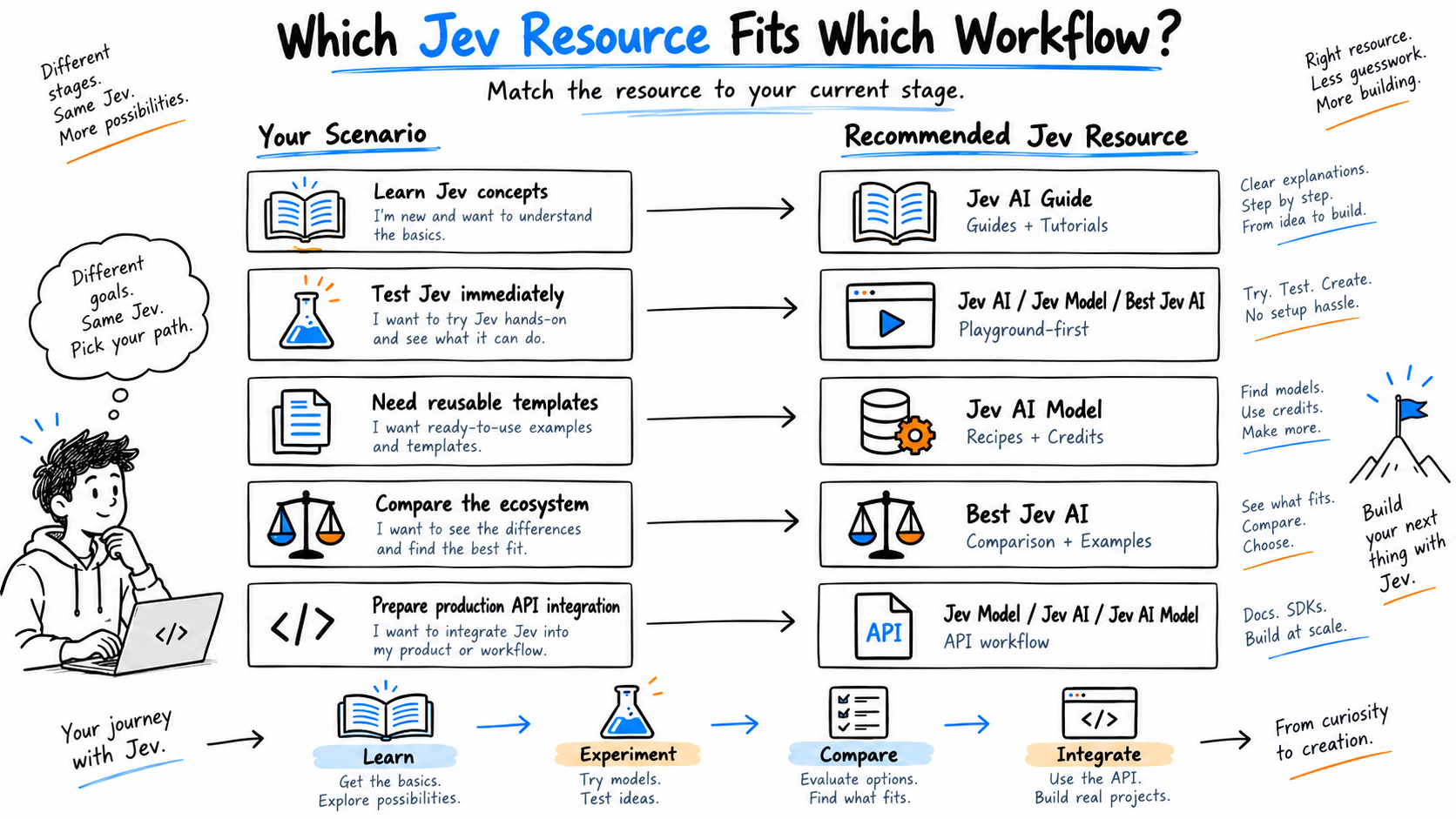
3. Jev AI Guide — jevaimodel.org
Jev AI Guide is positioned differently from the Playground-first products.
Its primary role is educational.
Instead of starting with:
"Run the model now."
the more useful question here is:
"How should I think about Jev and where should I use it?"
The site is positioned around:
- technical guides
- tutorials
- Jev AI explanations
- implementation patterns
- blog content
- practical solutions
- developer education
This becomes important because structured decision systems introduce a different design mindset from ordinary prompting.
Learning the Decision Contract
With traditional generative AI, developers often begin with a prompt and iterate on the response.
With Jev-style systems, it is often more useful to begin by designing the contract.
That means deciding:
What state does the model need?

What question am I actually asking?

What outputs are valid?

How will the application use the answer?

What probability or confidence level should trigger review?
